 Riding Tools
Lane positions
What’s lane positioning?
Motorcycles are generally narrower than cars, and can ride in a single lane in different positions. Many motorcycle training curriculum refer to these, and may do so differently. When I talk about lane positioning here, this is what I mean.
Here’s an ordinary highway near Hamill, SD (specifically SD49 about 9.5 miles south of Hamill, and probably facing due north).
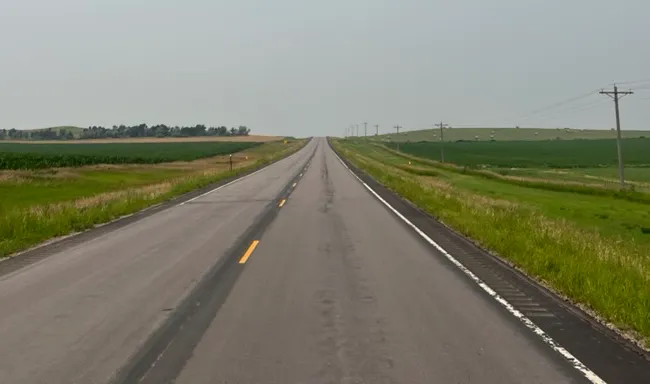
It’s pretty ordinary, with one lane in each direction separated by a yellow dashed line.
Here’s how I see the same road when I’m riding.
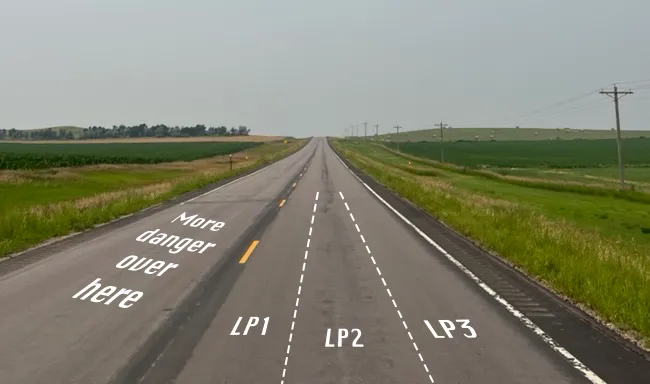
I have three distinct positions I can occupy in the lane, and each does have its purpose. If I’m riding on my own on a road like this in dry weather with warm tires and nobody else is around, I don’t usually have much preference. Maybe I tend to stick in LP2, because if something unexpected happens I have lane positions left and right to move into. I do often ride in LP1 on my own as well, as a) it’s habit from group riding, and b) I’m pretty easy to spot there while moving. I rarely ride in LP3 for reasons I’ll mention in a moment.
When I’m riding with someone else, I usually ride in a staggered formation. Unless there’s a really compelling reason not to, the lead bike is in LP1. This puts that bike closest to the center line where it’s most likely to be seen by others. The second bike rides in LP3, one second behind the first bike. The third bike rides in LP1, one second behind the second bike (which means two seconds back from the bike ahead in LP1), and so on. When we come to a stop, we collapse the line so that bikes are side-by-side in pairs, then we spread back out when we get rolling again. LP2 is used as needed (e.g., if there’s something in LP1 or LP3 that needs to be avoided, LP2 is available), but it generally stays empty as buffer space. Also, my main ride has wide hips, so riding in LP2 would increase the odds of actually bumping a fellow rider with side cases.
Some people ride with the lead bike in LP3 and stagger bikes the opposite way. I don’t like this because it puts that lead rider in the far right of the lane. To me this is harder for people to notice. It’s also why, when riding alone, I very rarely ride there.
Things to consider
LP1 and LP3 tend to line up with where car tires roll, which does affect road conditions. Sometimes these areas can be very worn, i.e., smooth, which can affect how the bike feels. They also can sometimes have more holes, or even be partially sunk lower than LP2. In comparison, LP2 may not have as much wear, but it does happen to be where the bulk of oil or other fluids leaking from many vehicles tends to fall. In fact, if you look at the photos above, you’ll probably see signs of exactly this.
Oil on the road isn’t usually a problem in dry, daylight conditions. Where it starts to get ugly is when it rains, particularly if it’s a very light rain that doesn’t really wash stuff like oil, dust, and other stuff off the road. The key safety thing here is, in wet conditions (and especially when roads are first getting wet), consider whether LP1 or LP3 is safer, increase your following distances as needed, and slow down.
One other thing to consider is which lane position to be in when you stop. If you’re riding solo, consider moving to LP1 or LP3 (or, if legal in your area, safe, and conditions allow for it, filter past vehicles in front of you). You may be slightly more conspicuous if you stay in LP2, but you’re possibly in a more dangerous position if the person behind you sandwiches you between cars. Being in LP1 or LP3 gives you the potential opportunity to slip past a vehicle in front of you with minimal effort and might also spare you from being crushed between cars.